Wednesday, 26 May 2021

Musical influences

Whilst watching last weekend's Eurovision Song Contest - nil poi - I was reminded by this dubious annual spectacle of just how popular it was with a certain Steve Midnight, formally the man behind Radio Confusion and latterly Subterranean Sounds. 

When the respective juries had concluded their 'and 12 points go to...' voting critique on what we had by then suffered through for at least 3 and a half hours, Subterranean Sounds would usually be found on 3 MHz around the witching hour with Mr. Midnight's own brand of post-contest fallout; this in itself would be as synonymous with the evening as the once-a-year cacophony staged in the name of European unity and friendship.

Any interest or otherwise I had in Eurovision was though coincidental, and not influenced by Subterranean Sounds' homage to a contest that now seems to exist to simply defy its detractors. Its inadvertent link to one of the UK's finest free radio stations from the 1990s might otherwise be tenuous, but it got me thinking as to how my interest in the shortwave pirate scene influenced musical tastes which have stayed with me to this day.

It is with this in mind I ask myself which came first? Was my interest already set upon the various musical genres that I was glad to hear that were seemingly shared by several free radio operators, or were the tastes I subsequently developed shaped by hearing music on shortwave free radio that would otherwise be shunned by legal, maintream FM stations - the only other outlets at the time for listening to contemporary and older tracks?

The answer undoubtedly straddles both outcomes. I was always pleased to hear, on for example Bill Lewis' Live Wire Radio, the latest releases that appealed to me but somehow, sounded better on shortwave. Three examples spring to mind: Maxx - Get-A-Way, Snap's Rhythm is a Dancer, and Shake Your Head by Was(Not Was) featuring Kim Basinger and Ozzy Osbourne may not have aged particularly well, but were favourites at the time, and still find their way into my playlist.

It is though the music which I was introduced to by free radio operators that has stayed with me for the best part of 30 years of which I the most grateful, with a varied diet that discursively segued from one extreme to another without the need for explanation or apology, something that set shortwave pirates apart from the heavily restricted playlists foisted upon resentful presenters of legit operations.

It is once more to Live Wire that I look to for piquing my interest in L7 and in particular Metallica, on whom I have since become something of an expert. Belting out 'And Nothing Else Matters' after the Prodigy's No Good(Start the Dance) but before the refrains of Ofra Haza and Scarlet Fantastic detail in miniature just what set Live Wire apart, notwithstanding the outstanding attention to technical detail that usually delivered a signal and audio clarity that many envied, but few if any could emulate. 

Subterranean Sounds did also introduce me to individual tracks I was unlikely to hear elsewhere, especially in my rather unenlightened backwater of the time. The likes of Air and Dubstar became relatively well-known for a time, but my introduction to their respective bodies of work was through the exquisite taste of Mr. Midnight, and not BBC Radio 1's Top 40 or my local Independent Local Radio(ILR) stations. FM pirate stations broadcasting not a million miles away from Subterranean Towers would have enabled Mr. Midnight to hear a greater variety of then modern music, and his subsequent airing of Jungle/Drum 'n' Bass tracks was I am sure a first for shortwave free radio, and instigated my admittedly ephemeral interest in this style of musical expression.

As far and away as different as you can get from indie-dance, Metallica-type metal, and offshoots of rave and urban culture, American rock giants The Eagles became a firm favourite of mine thanks to Weekend Music Radio's(WMR) Jack Russel being such a devotee, something that was often betrayed in his track selection that would also include the solo work of former band member Joe Walsh. And then there was Fancy Pants - Acker Bilk's clarinet classic which always bookended WMR's programmes. 

Elsewhere, tracks such as Kim Appleby's Don't Worry, invariably heard on Paul Stuart's Station Sierra Sierra, Magic Fly by Space that would usually mark the end of WNKR's(West and North Kent Radio) transmissions, and Pink Floyd's Another Brick in the Wall, played each week on 6280 kHz by Ozone Radio's Prince Terry helped broaden my musical appetite through  these subtle, deeply contrasting, but worthy yardsticks of their respective genres.

It is undoubtedly true that I favour the music I do so today because of the countless, often nocturnal hours, spent listening to the likes of Live Wire, Radio Confusion/Subterranean Sounds, Radio Orion, the Xenon Transmitting Company(XTC), WMR, Station Sierra Sierra and others. 

As a 5-year old I was apparently obsessed with Blancmange's synth classic Living on the Ceiling, a track I reawakened to 19 years later after hearing it on a certain UK-based powerhouse free radio station. To this day it remains one of my favourite tracks of all time and one of the best, if not the finest of its type - Blue Monday included. It was the musical policy that actually wasn't an organised policy at all, that brought this and the aforementioned tunes, as well as many others to my attention and that have endured in my affections ever since.

In an attempt to seek meaning in free radio, and the whys and wherefores of the motivations attached to each operator's desire to broadcast on shortwave, it is easy to over think what made the UK shortwave scene so appealing during the 1990s. It of course meant different things to individual listeners at contrasting stages of their lives, but music has always been a unifying force between often very dissimilar people that share perhaps just one common taste. 

Where legal stations seem to want their listeners to think that Guns N' Roses only sang Sweet Child O' Mine or that music began no longer ago than when Taylor Swift first shook it off, it was the unrestricted playlists of free radio that opened up a whole new world of listening possibilities to a young teenager that have endured ever since. In the relative excitement of hearing stations that were in effect illegal, it has been overlooked by me until only very recently just what part the musical selection played in the overall aural attractiveness of much of what I heard. 

Perhaps I have more to thank free radio for than I realised. 

Tuesday, 27 April 2021

And thanks go to...

In what is a final final post on my blog dedicated to UK-based shortwave free radio stations of the 1990s, it is only fair that I thank those who have given encouragement, honest appraisals, and nuggets of information which have filled in the gaps of my memory, and helped bulk out posts with data that hitherto I was unaware of.

Firstly, Paul at the thorough Shortwave DX Blog and Pirate Memories Blog for his emails and inclusion of my efforts within the list of blogs which he follows, therefore broadening the admittedly limited reach of what is a niche within a niche, within a niche. 

The emails of Kai Salvesen have in particular been a source of great interest and help, the content of which often mirroring my own experiences and emotions precipitated by the 1990s free radio scene.

After many years had passed since I was a member of the British DX Club I was pleased to make contact with Tom Read, someone I remember as a free radio expert during the 1990s and a frequent communicator with many of the scene's operators.

Still going strong and one of the last bastions of quality talk-based free radio on shortwave, Matt Roberts of the Xenon Transmitting Company(XTC) has on occasions helped steer the blog away from conjecture and assumptions into the calmer waters of factually correct information, whilst reading my words both from the perspective of a current broadcaster and one who did so as XTC and initially Radio Mutiny 'back in the day'.

I have also enjoyed stepping back in time by exchanging emails with the legendary Jack Russel of Weekend Music Radio and Trevor Brook, operator of Radio Fax - a station that existed on a rich diet of speech-based programming and took the fight for official recognition to the very top. It was also good to hear from Dave Norris formerly of Radio Blackbeard and Galaxy International, who can periodically be heard on Buzz FM and the Melton Mowbray-based community station The Eye 103 - as can Paul Stuart, once upon a time of Galaxy International and the enigmatic Station Sierra Sierra.

Thank you also to Mike Barraclough for giving readers of the Free Radio Forum the heads up about my blog.

My apologies to those I have inadvertently overlooked, and thanks to all who have read my at times rambling and discursive words. I would like to think there was more mileage in the blog, but sadly that is not the case. It was always going to be a difficult task to wring more and more out of what was a finite subject stymied by drawing on memories, a lack of hard copy material, and a relative dearth of online research material.

If though anything substantive and unique comes to light(or memory), I will be more than happy to revisit the subject. As ever, your comments, memories, and corrections are most welcome, and will be replied to expeditiously. 

We may meet again, who knows, but for now it really is goodbye. 

Saturday, 10 April 2021

Redux: Shortwave 'Pirate' Radio in the time of Covid-19 provided much needed entertainment and reminiscence

FIRST PUBLISHED A YEAR AGO ON A DIFFERENT PLATFORM AND IN THE WAKE OF MY OWN PERSONAL EXPERIENCE WITH THE NOVEL CORONAVIRUS, THE FOLLOWING CHRONICLES AN ALMOST ENFORCED REINTRODUCTION TO UK-BASED FREE RADIO ON SHORTWAVE DURING A LENGTHY PERIOD OF CONVALESCENCE. 

REPRESENTING THE FINAL POST OF AND A FITTING CONCLUSION TO THIS BLOG, MY WRITING STYLE AND THOUGHTS MAY SLIGHTLY DIFFER FROM MORE RECENT POSTS, BUT THE OVERALL MESSAGE REMAINS CONSTANT: THE 1990s WAS A GOLDEN PERIOD FOR FREE RADIO, PARTICULARLY IN THE EARLY YEARS OF THE DECADE, BUT ITS RISE, DECLINE, AND FALL VERY MUCH MIRRORED SOCIETAL CHANGES AND TECHNOLOGICAL ADVANCEMENTS THAT HAVE MADE LISTENING TO AND BROADCASTING ON 'GOOD OLD SHORTWAVE' SOMETHING OF A DYING ART, AND ARGUABLY A SOMEWHAT TWEE PASTIME. 

MANY THANKS TO ALL WHO HAVE VIEWED, CONTRIBUTED, AND COMMENTED. ALTHOUGH THIS IS TECHNICALLY THE END, I STILL WELCOME ENGAGEMENT WITH ANYONE WHO LISTENED AND CONTRIBUTED TO THE RICH MOSAIC OF 1990s FREE RADIO, AND THOSE WITH A GENERAL INTEREST IN HOBBY PIRATES FROM ANY ERA. 

___________________________________________________________________________________

Aged in my early teens in the Autumn of 1990, little could I have known that randomly tuning around the international shortwave bands on a basic analogue radio one Sunday morning would spark a hobby that has, albeit intermittently, endured to this day.

Already moderately aware of what could be heard using just a bog standard wireless and built in telescopic antenna, I was nevertheless surprised that Sunday morning to hear British(and Irish) accents and contemporary pop music in one specific area, the 48/49 metre band, approximately between 6100 - 6400 Khz. These 'stations' sounding more as if broadcasting from my neighbourhood than over the international broadcasting spectrum transpired to be pirate, or Free Radio operators, to correctly moniker the scene's preferred title.

The early days of UK pirate radio activity inevitably went hand in hand with offshore broadcasting, including the pioneering and most famous exponent of its genre, Radio Caroline. As broadcasting from ships was in reality the preserve and luxury of the few,  transmitting from bedrooms, garden sheds, and out in the field, the latter seen as the least likely location to be detected, became the norm for hundreds, perhaps thousands of UK-based FM and shortwave stations. The three stations I first heard that October morning were to be no exception.

Of the tripartite of stations - Ozone Radio International, Radio 48, and Live Wire Radio - I became great friends but sadly lost contact with 'Mr. Live Wire'. Powering out a strong and stable signal which reached North America, this English-based operator became for many years a firm favourite amongst free radio aficionados for his initial broadcasts on the 6.6 MHz 'Echo Charlie' band before migrating to where most of the action lay on 48 and 76 metres, with also some notable broadcasts in FM mode on 15 MHz.

My interest in free radio continued to grow. Once it became apparent that these three stations were but the tip of the iceberg I dedicated my weekends, in particular Sunday mornings, to hearing, and contacting, as many operators as possible. Some great listening ensued, from the likes of Weekend Music Radio in Scotland, to Radio Confusion and its nominal successor Subterranean Sounds based in the south of England. With as many if not far more shortwave operators located in the Netherlands but relatively few elsewhere in continental Europe, I all of a sudden became a correspondent at 14-years of age with exotically sounding stations like Radio Orangutan, Ozone, and in the years to come Radio Fusion from Sweden, and the French-based Radio Waves International.

As my teenage life progressed and atmospheric conditions made listening at times in the mid-1990's almost impossible I increasingly dipped in and out of free radio, as did some of its higher profile operators. Some disappeared for good; others, like Live Wire Radio concentrated on medium wave broadcast amongst the many Dutch operators around 1636-1660 Khz and nighttime 3 MHz programmes. Perhaps it was often forgotten by listeners lamenting an absence of their favourite stations but operators too also have lives, relationships, and changes of circumstances just as we all do.

The early to mid 90's undoubtedly contained a golden generation of UK shortwave free radio stations, or, perhaps as a relative youngster had I been taken in by the notion that everything was better in the past, at least compared to our current technologically advanced but spiritually and morally bereft era? This isn't though a hagiographic depiction of life as it was, merely to paint a pejorative picture of modern life. Quite simply, be it a crop of footballers, pop groups, or free radio stations, clusters of those bound together by a shared passion and/or skill do without rhyme or reason inexplicably occur in tandem. It is not for us to ask why - there often isn't an answer - but to simply enjoy a period of time all the more fleeting before it eventually flies too close to the sun or circumstances get the better of it.

As atmospheric conditions fluctuate on a daily basis - something that has happened time immemorial - the one constant that hampered operators and listeners alike was an inexorable increase in background noise, electrical interference - call it what you will. The proliferation of electrical devices within households and subsequent everyday normalcy of handheld telephones has made conventional listening with a radio and longwire antenna a thing of frustration for those in built up areas.

The advent of Software Defined Radio(SDR) now enables listeners to hear stations wherever SDR receivers are located. Should for example an individual audience member based in Manchester find online an SDR located in Sweden, he or she can then hear the shortwave bands as if they were sitting back with a coffee and cigar in Stockholm, or wherever in Sweden the remote receiver happens to be based. Should a report be filed to the station its operator will then know that he is being heard in Sweden, albeit by a listener based in the north west of England. Is this cheating? Maybe, but if it helps keep the art of shortwave free radio alive I view this as one piece of modern technology that hasn't completely unromanticized the notion of the one man band, homebrew operator broadcasting from where, who know where, to be heard on a laptop or smartphone instead of more traditional equipment.

The current Covid-19 outbreak has for me been a twofold issue. Locked down, quarantined, call it what you will and what the population are having to endure is of course a problem for all, not just me. I also though succumbed to novel coronavirus, which heralded some dark, uncertain days before my eventual but slow recuperation took effect. This, and the generic lockdown has given me plenty of time to think, rest, fret, but also dip my toe back into the world of free radio.

Although sounding very different to its heyday I have enjoyed rolling back the years, both from the simple act of listening and being frustrated by trampolining conditions and stations that fail to identify themselves, but also hearing several operators that I haven't done so for years, or those who I have happened across purely because of my incapacitation.

A QSL card is a written confirmation from a station that the listener indeed heard its output, and something which became collectible in all sphere of radio listening. As a youngster I received by default many QSL cards from stations throughout the UK and overseas, including mainstream broadcasters Voice of Vietnam, Radio New Zealand International, and the Moscow-based Radio Peace and Progress. I never per se wrote to free radio operators as a QSL-hungry listener but more as a novelty of corresponding with the otherwise mysterious and faceless who took calculated or otherwise risks every time the rig was switched on.

This form of verification nevertheless found its way back from station operators to my mailbox, although sadly my archived collection has long since bitten the dust. Having though made contact during my Covid-19 hiatus with several UK and Irish stations, revisiting the 'back in the day' novelty of receiving QSL cards in real time has engendered strange feelings of nostalgia, but also those of simple enjoyment which in the grand scheme of modern life has become far more difficult, even to the point of ridicule.

Here are some of the recent QSL cards received during my enforced convalescence:

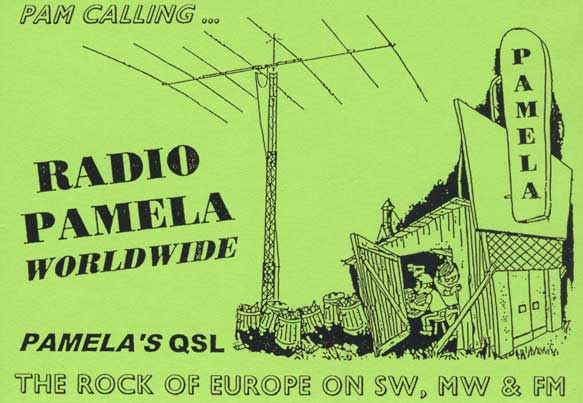
pamela1

Radio Pamela's operation by free radio legend Steve Most predates even my earliest interest in the pirate scene. Although a periodic broadcaster Pamela has seemingly gained a new lease of life and can be often be heard, as 'she' was this morning, on 6940 Khz in the 43 metre band.

XTC QSL

As one of the original 'classic' pirates of the golden 90's era, The Xenon Transmitting Company, or XTC, was first known as Radio Mutiny before adopting a more abstruse name squarely in keeping with the station operator's identity - Tommy Teabags. I have at times gone several years without hearing XTC, whose broadcasts prior to the pandemic were limited to bank holidays. As can be seen in the above QSL XTC has once more made several very welcome appearances on the 48 metre band, with special Lockdown Special shows! As the years catch up with us all and maturity casts a depressing but necessary shadow, Mr. Teabags has now reverted back to the less outlandish sobriquet of Matt Roberts, who first identified himself as such during the early days of Radio Mutiny.

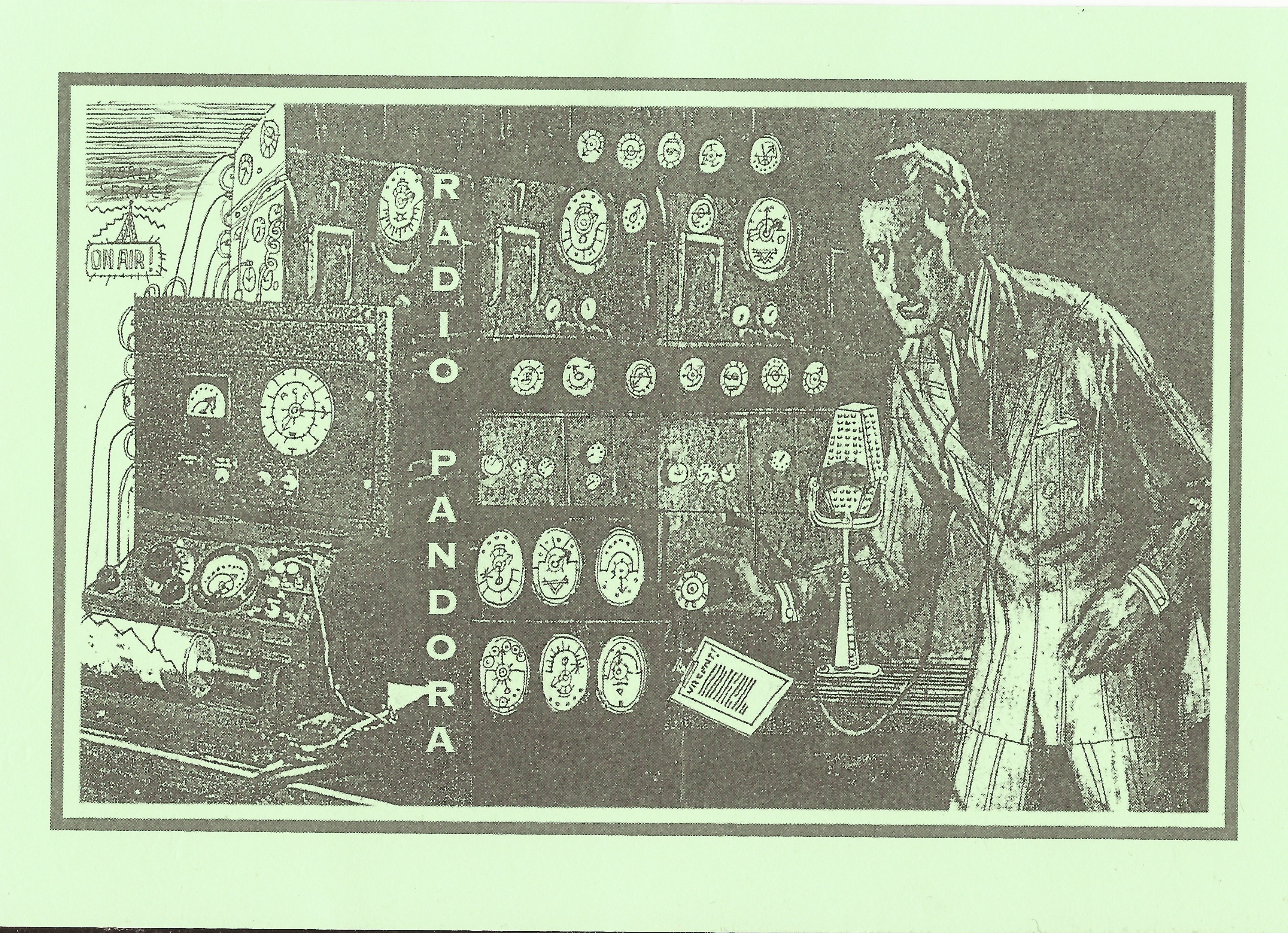
Pandora England QSL 2

The third QSL is also a fellow UK station of Pamela and XTC. Despite broadcasting since the mid-90's operator Steve St. John has only been heard by your correspondent perhaps on a dozen occasions, with atmospheric conditions and technical problems precluding good, or any, reception of Pandora's broadcasts. Despite approaching his 70th birthday the ever-chuckling Steve has recently been putting out some belting signals on 6322 Khz and can credit the technical expertise and advice of Live Wire Radio's former operator with such vastly improved signal and modulation.

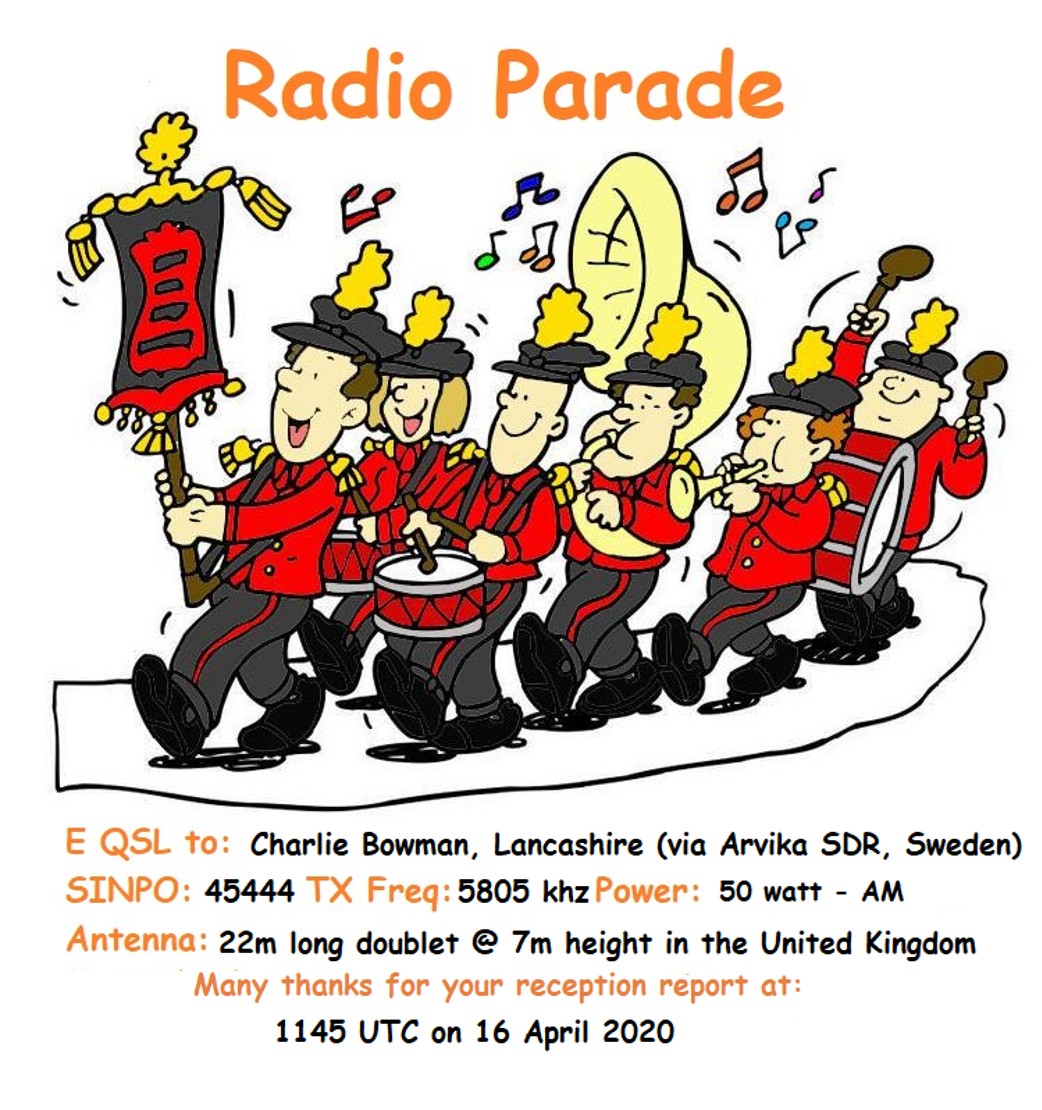
EQSL Radio Parade

Although present at various times during the last several months on the 76 and 48 metre bands, as well as 5.8 and 6.9 MHz, I hadn't previous to last week had the pleasure of officially hearing Radio Parade, another UK-based station. The obvious distinction I can make between Parade and most, if not all other free radio stations, is a particular fondness by Alex, the station operator, to broadcast instrumental, classical, and niche output. The power used and broadcasting setup, combined with the slightly higher frequencies favoured often results in Parade being barely audible in the UK, or at best heard via the North West Ireland Kiwi SDR remote receiver or that based in Arvika, Sweden. Identification is usually confirmed by sporadic canned announcements, although piano concertos and instrumental pieces act as ersatz and distinguishable points of reference.

It is impossible to say whether my rejuvenated interest in free radio will continue once fully recovered from my own brush with Covid-19, and that the strictures of lockdown have finally been loosened. It is certainly not a foregone conclusion to assume the pirate scene will always be there but in one guise or other, the 48 metre band will remain a constant to the many or few for some time yet. Fluctuations in quality and quantity of stations and atmospheric conditions are a given, but a resurgence in listening using conventional and/or SDR technology will hopefully encourage those operating to continue to do so, and perhaps too a new breed of operators to take the hobby into the next generation.

A Free Radio Holy Trinity

What makes a shortwave free radio station popular? Everyone will have their own opinions, with no answer correct or otherwise in itself. How...