Monday, 27 March 2023

From Chopin to Kim Appleby - the memorable signature tunes of shortwave

The world of shortwave radio has always been a complex arena for all manner of broadcasters - from the legal to not so, along with mysterious bursts of utility and baffling numbers stations. Whilst free radio was not the instigator of my interest in shortwave, far from it, it soon took over to become the dominant part of the hobby despite at the time 3 - 30 MHz being a necessary 'go to' window on the world now all but engulfed by the internet's all-consuming tentacles. 

Within this blog I have previously chronicled how stumbling upon Radio 48, Live Wire Radio, and Ozone Radio International one Sunday morning in October 1990 opened up a whole new world of broadcasting which made even the exotically-located shortwave stations I had received up to that point seem staid and predictable. They of course were not, but to a then fourteen year old hearing everyday people broadcasting from their homes or out 'in the field' on the same bands as for example Radio Havana, Voice of America, and Radio Pyongyang really blew my mind. Throw in interesting chat, live interaction with listeners, and eclectic tastes in music I was sold from the first time of asking, but without my initial interest in legal shortwave stations I would never have known about or heard the likes of Weekend Music Radio, Radio Confusion, or Radio Fax.

For perhaps eighteen months prior I had listened to, and communicated with, all manner of stations using my modest, analogue listening station with the accompanying telescopic antenna complemented by a short long wire  - an oxymoron if there ever was one - connected to my bedroom curtain rail. At that point I was a slavish devotee of QSL cards, and anything else national broadcasters would send me. It was interesting to see how some obviously had far larger budgets than others, but that would often be allied to individual ideologies being promulgated by the country in question through their shortwave mouthpieces. 

One of the most interesting aspects of 'legit' shortwave free radio in those days was the interval signals broadcast at the top of the hour, in other words between the ending of one programme and the start of another, or once a station had come on the frequency at the point between a dead carrier and the commencement of their next broadcast. Interval signals would often be short bursts of classical music, for example an excerpt of Chopin on Radio Polonia, or a vignette of a musical style particular to the country in question. Others were just random, or so they seemed at the time, but without overthinking things too much they perhaps simply sought a more distinctive sound to differentiate from the rest.

The most haunting and mysterious were inevitably from Eastern Europe and the Soviet Union, in a time when the Warsaw Pact bloc were just about in tact but as the Berlin Wall fell, the USSR was not too far behind. The interval signals weren't defined by the presence of the Iron Curtain, but there was always a certain frisson of excitement when the 'calling card' of Radio Tirana or Radio Prague wafted across the airwaves. I always felt there was a certain irony that part of RAI Italy's interval signal was incessant bird song; a bit rich from a country so fascinated with killing as many migrant birds as it can.

I do not know if many of these shortwave stations still exist let alone their interval signals, but there is a tremendous number of resources on YouTube to allow a healthy does of wallowing in times past. As my interest in shortwave free radio grew at the expense of the likes of BRT, Radio Australia, and Radio Damascus I became accustomed to different types of music that became emblematic with certain free radio stations, for example Acker Bilk's Fancy Pants on Weekend Music Radio, with Station Sierra Sierra favouring Kim Appleby's Don't Worry, whilst we all knew the Wizard was in town on hearing Sniff 'n' the Tears' Driver's Seat. An honourable mention should also be made for Prince Terry's fondness for Pink Floyd's Another Brick in the Wall. These were great, far simpler days.

What follows are a few examples of correspondence I had with Radio Moscow and its Soviet compatriot, Radio Station Peace and Progress. There is of course a certain modern-day irony in the latter's title, but I continue to hope for peace in Ukraine, Russia, and Belarus.




Monday, 9 January 2023

Now for something completely different...

Although Radio Orangutan was one of the first free radio stations I ever heard on shortwave, I always favoured the output of UK-based stations over that of their continental counterparts. That is not to say there wasn't anything worth listening to from outside the United Kingdom, but as a very young man at the time it was always inevitable that I'd prefer English language broadcasts to those in foreign tongues. 

Of all the European pirate stations who broadcasted during the 1990s, I probably only contacted half a dozen or so compared to somewhere between 40-50 UK and Irish-based operators. Those from memory would have been France's Radio Waves International, Sweden's Radio Fusion, and the Dutch quartet of Radio Baanbreker, one of the Radio Deltas, Radio Silverbird, and the mighty Radio Barones. There may well have been others who don't readily come to mind, but I doubt it.

In more recent times I have become frustrated with what I regard as disrespectful behaviour from some continental operators who fail to check the band before switching on their rigs, often with the result of swamping stations who have already commenced broadcasting. In mitigation atmospheric conditions can result in stations who are audible in the UK not being so in for example Germany or the Netherlands, but this is where the expedient use of Software Defined Radio receivers located in other countries can help overcome any potential antisocial behaviour, inadvertent or otherwise. 

A contemporary station with a towering signal and to me at least a superb dedication to dance music, Radio Joey has I believe upset other stations in the past by obliterating the band with its significant presence, but in more recent times appears to be far more aware of those with whom it should coexist. I have witnessed Joey move frequency to presumably avoid interference and/or to be respectful of other stations, for which the operator should be applauded. 

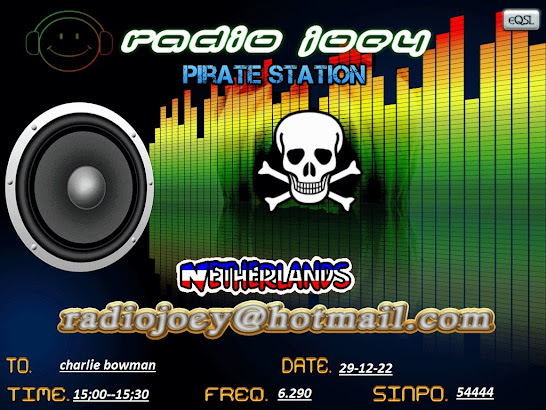
Between Christmas and new year I heard a fairly brief but positive music-dominated broadcast from Radio Joey, accompanied by the usual strong signal and superb modulation. I haven't asked anyone for a QSL card in the last twenty five years but I was nevertheless surprisingly pleased to receive the below in response to my email to the station:


The golden days of free radio in the vein of how it became known to me are now as far off ago to almost feel like they never existed, but for just one brief interlude whilst listening to Radio Joey I was taken back to the power house signals of Live Wire Radio and Weekend Music Radio, both of whom had the chat and music policy to retain the attention of their listeners. Musical taste is highly subjective, but for me at least the duality of a big signal and a pleasing soundtrack briefly reminded me of much of what initially attracted me to free radio some thirty two and a half years ago.

Monday, 5 December 2022

Old recordings

Several months ago, I put out an appeal to anyone with an archive of free radio recordings from the 1990s with a view to them being digitised for the internet age. Well, although it seems that my request fell on stony ground I have recently unearthed, on YouTube, a cache of fascinating clips of UK stations from the decade in question.

Whilst Achim Brueckner's website has a wealth of free radio recordings including many from UK-based stations, the sheer number of files on his website can make it somewhat time-consuming to find exactly what you are searching for. By that I do not intend any criticism of what is an incredible cornucopia of free radio miscellanea, but I am indeed fortunate to have recently stumbled across the Pirate Radio Archive YouTube channel which has a comprehensive mix of recordings that spans the lifetime of free radio from the 1960s to the present day. 

In keeping with this blog's reason for being, here are some highlights:


The big cheese himself, Bill Lewis of Live Wire Radio.


Radio Confusion, which later became Subterranean Sounds.


The inimitable Jack Russel of Weekend Music Radio.


A very young sounding Matt Roberts of Radio Mutiny, later to become the Xenon Transmitting Company.


Radio Orion, with the late Paul Johnson of UK Radio at the controls. 


48 metre band regular, West and North Kent Radio (WNKR).


Radio Pamela, still going strong 30+ years later. 


The late Norman Nelson of Radio East Coast Commercial. 


Paul Stuart of Centre Radio International that became Station Sierra Sierra, with the operator also being one half of 'out in the field' station Galaxy International. 


Radio 48, the first free station I ever heard on shortwave. 


The above is just a flavour of what could be heard broadcasting from the UK on shortwave during the 1990s, particularly the earlier part of the decade, but there will of course be other stations from the era to be found on the excellent Pirate Radio Archive YouTube channel.

This blog has somehow staggered along to its fiftieth post and will therefore raise its bat to the pavilion for a well-earned half century. It has retired more than once only to re-emerge with more 'never can say goodbye' musings on a great era of free radio, a genre that was though already in decline from its golden, halcyon era from the 1960s to the mid to late 1980s. 

It is of course relative to when one started listening to hobby pirates, with the 1990s representing a significant high-water mark compared to subsequent decades, but those who listened in the preceding years will likely say it bore no comparison to what went before. Different times, people, technologies (including mediums of communication), music, expectations, standards, and societal norms are all reflected in how free radio has changed.


*MORE OF MY WRITING CAN BE SEEN AT: 

alpineandcentralasiaissues.wordpress.com


A Free Radio Holy Trinity

What makes a shortwave free radio station popular? Everyone will have their own opinions, with no answer correct or otherwise in itself. How...